
The City of Kirkland has asked me to provide surface water management priorities for the Finn Hill neighborhood via a survey developed by Kirkland Public Works. The survey will be used to update the Kirkland Surface Water Master Plan to guide work that will be done across the City for the next five years. The survey is useful to Finn Hill residents because it helps us to clarify and communicate surface water priorities for our neighborhood.
I have provided a draft of my survey responses in the space below. The statements I have drafted are for our Finn Hill neighborhood, not for any other neighborhood. Each area of Kirkland is unique. I encourage you to use the comments feature in this blog to provide your comments, opinions, and suggestions.
I plan to update the survey responses to include feedback from the neighborhood and then submit the survey to Kirkland sometime during the week of 25-Mar-2013.
Thank you for your participation in this process.
Respectfully,
Lou Berner
For background information on the Finn Hill Surface Water Management Project, see:
- FHNA Surface Water Management
- Surface Water Management & Drainage Concerns (PDF)
- FHNA Surface Water Management: Project Update
- Report a surface water issue. To launch the survey, click here.
Kirkland Surface Water Master Plan – Stakeholder Survey for Public Involvement Needs
You have been identified as a stakeholder in the Surface Water Master Plan.
As you probably know, Kirkland’s Surface Water Master Plan is a 5-year plan that sets the priorities for the Surface Water Utility. The major goals of the Surface Water Utility are flood reduction, water quality improvement, habitat improvement, and infrastructure maintenance.
The plan will include a mix of programs and projects that is developed based on your interests, the need to comply with state and federal mandates, and the need to keep utility rates reasonable. The plan will also recommend Surface Water Utility rates to support the recommended program.
The last Surface Water Master Plan was developed in 2005, and can be viewed on the city website: 2005 Surface Water Master Plan. Today, Kirkland is looking to you to provide input on how the community wants to be involved in the development of the Surface Water Master Plan.
EXTERNAL
Q.1: Name of stakeholder:
Lou Berner, Program Manager for Finn Hill Surface Water Management
Q.2: Do you represent an organization as you provide input on the Surface Water Master Plan? If so, what organization?
Yes, Finn Hill Neighborhood Alliance (http://loqq.net/)
Q.3: How have you been involved with the Kirkland Surface Water staff, infrastructure (streams and lakes as well as pipes and ditches), or programs before?
Since 2001, I have been a consultant to the DCNA or FHNA Board of Directors, and I have also served on the Board. I have been a volunteer or project leader for habitat assessments, restoration projects, and various discussions about planning and zoning policy since moving to Finn Hill in 2001.
For recent work and results in the Finn Hill/Holmes Point area, see documents online:
- FHNA Surface Water Management
- Surface Water Management & Drainage Concerns (PDF)
- FHNA Surface Water Management: Project Update
- Report a surface water issue. To launch the survey, click here.
Q.4: What do you know about surface water issues in Kirkland?
Kirkland has a progressive and proactive approach to surface water management. Kirkland Public Works resources are enabled to identify state-of-the-art surface water and water quality solutions, to develop an ambitious vision for Kirkland, and to develop a plan to bring that vision to life in realistic, incremental steps.
Finn Hill projects that address surface water, water quality, and watershed management have utilized resources from Kirkland Public Works and Kirkland Information Systems departments for the past five years or so. The Finn Hill neighborhood was annexed into the city of Kirkland in June 2011.
Q.5: What do you need to know about surface water issues in Kirkland?
It would have been nice to have been able to collaborate with you starting 10 years ago.
Q.6: What are your current views about surface water management in Kirkland? See Q.4.
Q.7: How important is this Surface Water Master Plan for the Kirkland community?
The Surface Water Master Plan is important for several reasons:
- As a community in the Puget Sound Basin, it is important for Kirkland to do its part to manage surface water and improve water quality. As a progessive community with significant resources, we can set an example of what can be done to turn the tide in terms of water quality, habitat improvement, and quality of life.
- The Plan will assist Kirkland to interact with other communities to learn and to teach; information will flow both to and from our community.
- As methods improve and progress is made to manage water quality on a large scale, the plan will also assist us in contributing to the body of knowledge regarding surface water management.
Note: For Q.8, Q.9, and Q.10, the priorities presented are for the Finn Hill/Holmes Point neighborhood.
Q.8: In your opinion, what is the most important issue to be resolved with the Surface Water Master Plan?
1. Improve infrastructure and encourage low-impact development. Continue to work with individual landowners who have concerns about flooding, surface water conveyance, landslides, or water quality.
- Include low-impact development as part of planning process, increase the standards for low-impact development
- Capital improvements include:
- Daylighting Deny Creek under Juanita Drive to improve fish habitat and enable wildlife passage under the roadway. Include a pedestrian underpass as part of the project to improve traffic safety and pedestrian/bike safety.
- Improve footbridges, boardwalks, and trails in Big Finn Hill and OO Denny parks
- Daylight Whiskey Creek/Champagne Creek under Juanita Drive
- Remove the concrete bulkhead from the lakeshore at the north end of OO Denny Park
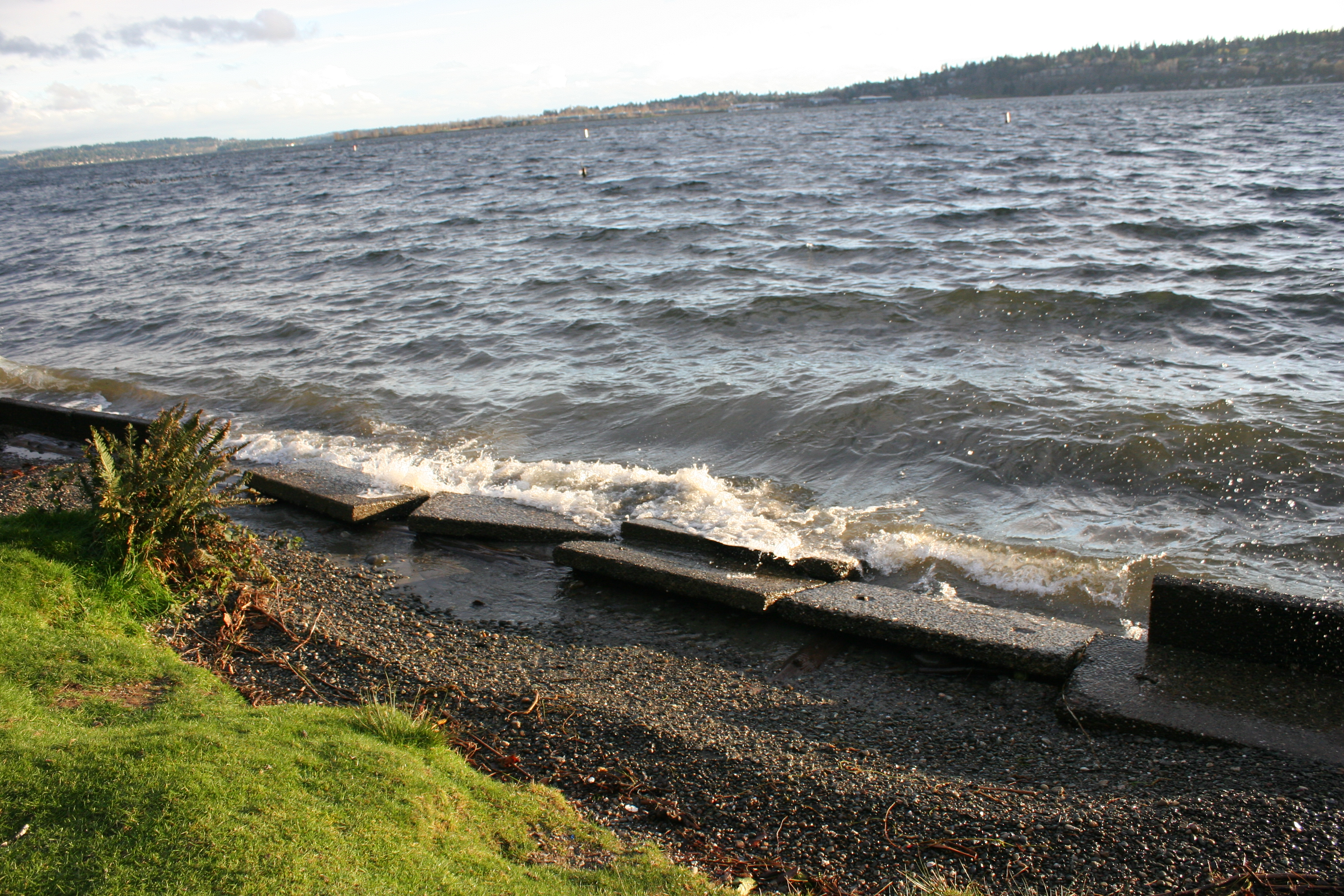
Remove the dilapidated concrete bulkhead from the OO Denny Park shoreline.
- Remove the wooden water tank and associated flotsam from the hillside at Holmes Point Drive and 64th Terrace
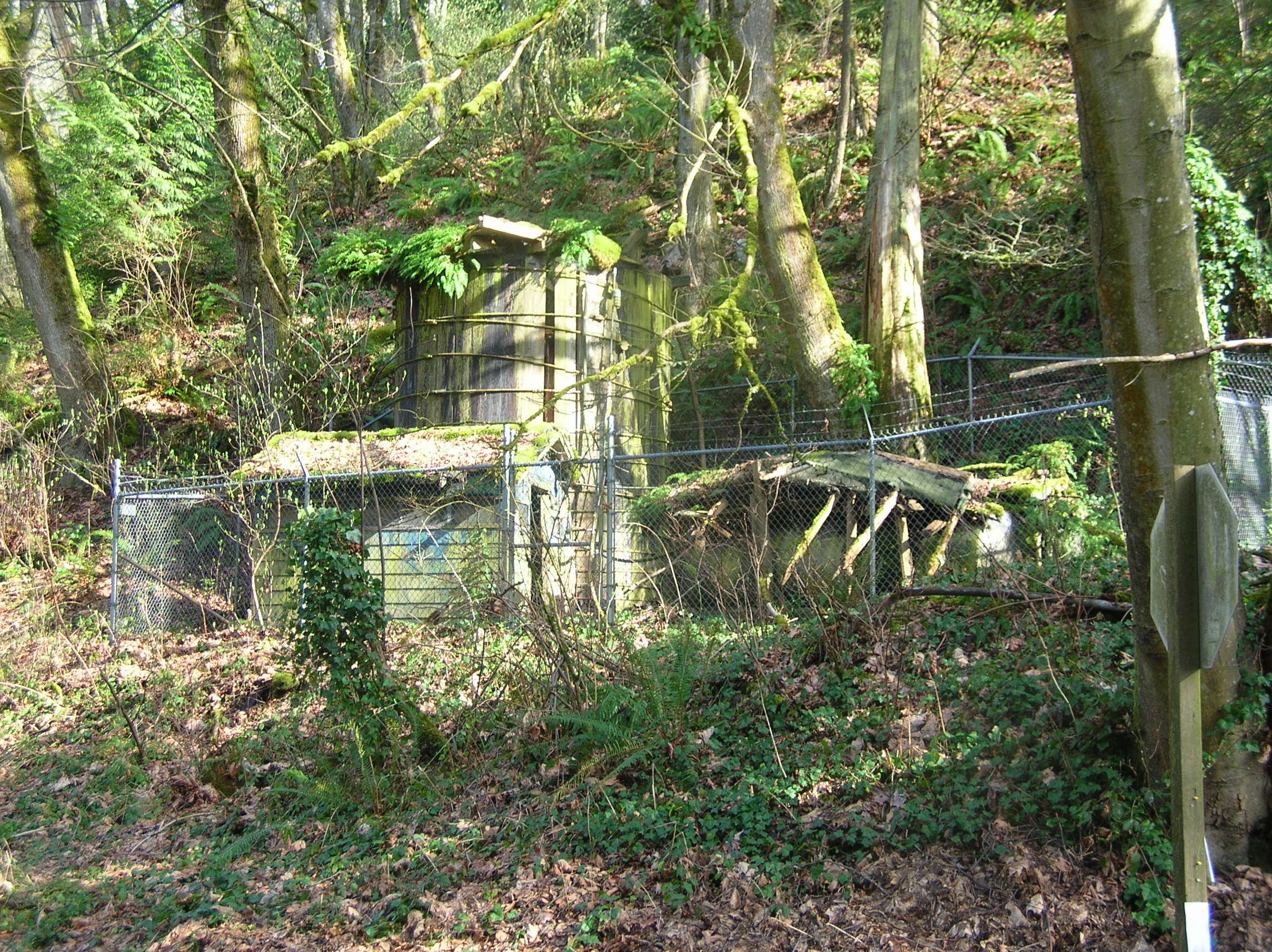
Old wooden water tank and associated flotsam along Holmes Point Drive.
2. Carry forward the recommendations from the 2007 Denny Creek Watershed Study
- Improve infrastructure: Repair and update retention ponds, construct rain gardens, repair or update old surface water infrastructure
- Monitor water quality and indicators of fish habitat quality
- Complete the map of storm water conveyance schematics for the Finn Hill neighborhood
Q8.1: What level of impact will this issue have on the community?
This work represents a backlog of projects and tasks considered “deferred maintenance” that have been carried forward from the time we were in unincorporated King County. Rain gardens and increasing standards for low-impact development are ways we can demonstrate that this neighborhood values its green roots. Leading the way in these areas shows that we value the character of our neighborhood.
Capital improvements are new projects that will improve water quality and improve the quality of life in the Finn Hill neighborhood.
Q8.2: What level of concern do you have about this issue?
It may take several years to clear this significant backlog of projects.
Q8.3: Does this issue change for specific watersheds or areas of the city?
These issues as presented here are only for the Finn Hill neighborhood. Other neighborhoods will have their own priorities that may be the same or different than ours.
Q8.4: If so, what is the geographical difference?
It varies from one Kirkland neighborhood to the next.
Q8.5: Do you feel the public can influence the decisions related to this issue?
Absolutely, yes.
Q.9: In your opinion, what is the second most important issue to be resolved with the Surface Water Master Plan?
Perform GIS analysis to map sub-basins across the neighborhood: Denny Creek, Whiskey/Champagne Creek, the west side of Finn Hill, and the east side of Finn Hill.
This work will identify geographic units within the neighborhood where each unit drains to a single tributary or outfall to lake Washington.
Q9.1: What level of impact does this issue have on the community?
This analysis will be of tremendous value to our surface water management project. Sub-basin analysis will allow us to identify targeted projects and develop specific improvements where we can make the most difference with limited resources.
Q9.2: What level of concern do you have about this second issue?
No concerns. We will get it done as resources are available within the City. Time frame: summer 2013.
Q9.3: Does this second issue change in different watersheds or areas of the city?
Other neighborhoods will have their own priorities.
Q9.4: If so, what is the geographical difference?
It varies from one Kirkland neighborhood to the next.
Q9.5: Do you feel the public can influence this second issue?
Absolutely, yes. Neighborhood residents will be included in the decision-making process that results from this work.
Q.10: In your opinion, what is the third (and final) important issue to be resolved in the Surface Water Master Plan?
This priority is a difficult one, but it is really important. It is the realization that, in order to be truly effective, surface water planning has to be coordinated with other efforts. Not just across Public Works, but across other departments and projects in Kirkland: traffic safety, planning/zoning, parks, and others; across other agencies: King County Parks, Washington State Parks; other cities: Bellevue, Redmond, Kenmore, and Bothell; and other organizations: Puget Sound Partnership, Puget Sound Action Team, Adopt-a-Stream Foundation, Sno-King Watershed Council, and Save Lake Sammamish.
As a Kirkland neighborhood, we have to partner across our own Finn Hill projects and committees, and also include local schools, other Kirkland neighborhoods, and partner with other organizations like Sno-King Watershed Council, Puget Sound Partnership, Puget Sound Action Team, Adopt-a-Stream Foundation, Save Lake Sammamish, etc.
Shared goals: Low-impact development, monitoring, water quality improvement, habitat improvement, targeted mitigation and small-scale solutions, encourage transparency and accountability, and share our story with other groups across the region.
Q10.1: What level of impact will this third issue have on the community?
Coordination will help to build consensus and include perspectives from a variety of stakeholders.
Q10.2: What level of concern do you have about this third issue?
It is likely to be difficult and sometimes frustrating.
Q10.3: Does this third issue change at different geographical points of the corridor?
Different perspectives will add value to the various projects.
Q10.4: If so, what is the geographical difference?
Q10.5: Do you feel the public can influence the decision related to this third issue?
Yes, public influence is valuable and necessary.
Q.11: What do you feel are the benefits to involving the public in the decision making process for Surface Water Master Plan?
By participating, we are helping to set the priorities for our neighborhood. If we help to set the agenda, then we have partial ownership of the projects in our neighborhood.
Q.12: How would you like to be informed or involved in the Surface Water Master Plan from here on out? Are there specific methods or techniques that have worked well for you or your group with other projects?
We use the FHNA web site – http://loqq.net – and e-mail to communicate with our Finn Hill neighbors. E-mail is a good method for most of us.
Q.13: Without knowing the list of people we are interviewing, is there someone you feel we should be interviewing for the Surface Water Master Plan?
I will circulate this survey to the neighborhood and ask the FHNA Board of Directors to provide comments. So, for Finn Hill, I think we are covered. Thank you.




Woohoo! You are great Lou! Thank you for all your past hard work and ofr continuing to captian this worthwhile project! My hat tips off to you!
Teresa
I was not aware that we had much issue with surface water.
There’s always Juanita Drive just inside the new annexation area, site of the landslide due to plugged culverts, I think. When we had a LOT of standing water there a week or two ago, Kirkland said it wasn’t their problem. Boy, you had water buildup (which meant the drains under Juanita Drive weren’t working?) and KC was out there right now. Now there is fresh dirt slide area in that spot.
Several spots have springs under the road that KC used to have to deal with….the one on JD at 86th…..lots of water running across the road a month or so ago….Kirkland crews were out doing something on the uphill slope….no solution, real spooky when it froze. The other spot is the steep hill on the east side of the hill on NE 141st Pl.
The road drain at the old KC/Kirkland dividing line….where we ended up with a slide and rollover when all that water froze a couple of months ago….are those the things Surface Water Management plans will address?
Or are we just dealing with stuff that the City doesn’t want in the drains…”Sub-basin analysis will allow us to identify targeted projects and develop specific improvements”.
I read the above twice and still am not sure I understand the issues fully.
Is it to collect and direct surface water away from crossing roads and freezing?
Or is is to try to find some farm runoff and deal with that?
I certainly hope it does not involve mandating storm drains, curbs and gutters in areas that do not have them.
Not enough of those areas left up here on the Hill.
Hey, Dave:
Thanks for your comments. For obvious reasons, runoff from Goat Hill will continue to be a challenge. I think that Kirkland resources have been very responsive to issues on Finn Hill and, since annexation, they have already made significant improvements. Do you disagree? For example, the spring under the street at NE 141st place has been fixed. It used to be a skating rink during freezing weather. Have you been over there to see it? You can read about it and other improvements in my Feb-2013 update at http://loqq.net/2013/02/update-finn-hill-surface-water-management-project/.
Regarding the sub-basin analysis, it is a computer mapping project that will outline areas on the map that drain to a single point. It will help us to pinpoint areas that can be targeted to improve water quality.
The overall surface water project is more than streets and drains and culverts, although those features are important. In addition to adding and maintaining existing surface water conveyance features, the project identifies changes we can make that will capture runoff and return it to the ground. If we can do that, we will prevent flooding, reduce mud slides and clogged culverts, and eliminate springs that seep up through the pavement, like the one on 141st Place.
We will also improve water quality in our creeks and help to reduce the impact of development on Lake Washington.
Lou,
Your survey responses and prior reports are an excellent outline of the surface water issues, concerns and priorities of the Finn Hill area. Great job!
Thx, Mic
Lou, you have done so much work for the Finn hill community! I’m so impressed!
Lou,
Thanks for the opportunity to comment.
Regarding Q8: I would prioritize mapping stormwater mgt utilities and determining whether they are functioning as intended. Subsequently, consider repair if utilities are not performing.