
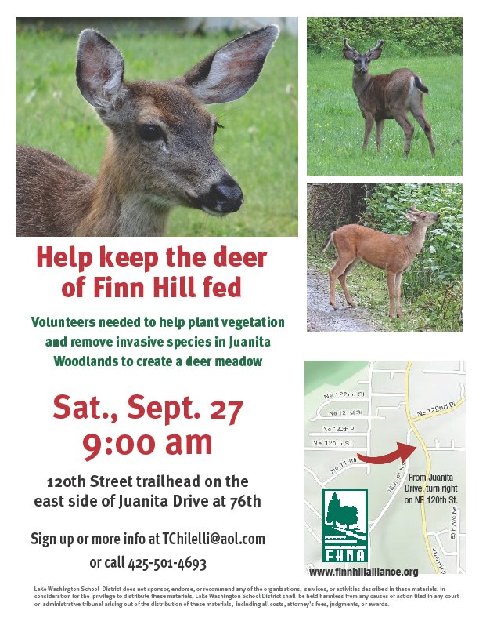
Help keep the deer of Finn Hill fed! This is the only woodlands event this year.
What: Volunteers are needed to help plant vegetation and to remove invasive species in Juanita Woodlands to create deer meadow.
When: Come join us on Saturday, September 27th at 9am
Where: Meet at 120th Street trail head on the east side of Juanita Drive at 76th.
Over the past few years, many of you have helped restore the Juanita Woodlands by planting over 5000 trees and removing seemingly endless mats ivy, blackberries, and archangel. This year, we’ve got something different in mind: we’re going to clear out a meadow for the deer that frequent the Woodlands.
We’ll be heading into the deep recesses of the park (sort of – the Woodlands aren’t that extensive), so you get to do a little exploring while lending a hand to Mother Nature and her creatures.
We hope you’ll join us on the 27th. Additional details to come.
The Juanita Woodlands is in need of a Volunteer Coordinator.
If you have an interest in stewardship and would like to care for the Juanita Woodlands please contact Teresa Chilelli using the contact form on this web site.
Tasks for the Volunteer Coordinator
- 2-3 times a year help send work party emails to the Woodlands volunteer list
- Assisting to place yard signs (A-Frames) to advertise the event
- Help during the work party event with sign in, refreshments, etc,
- Hours – maybe 10 hours leading up to each work party event (minimal – but rewarding)
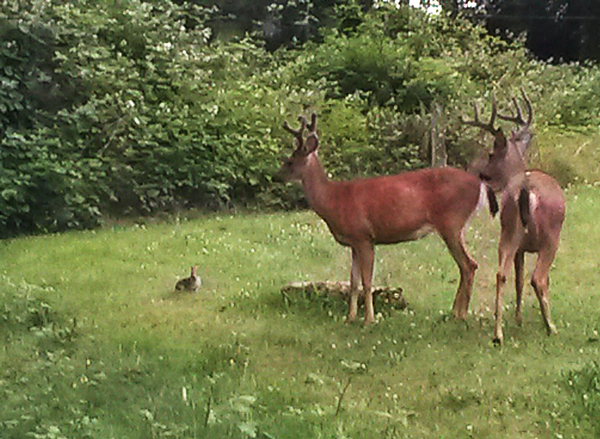
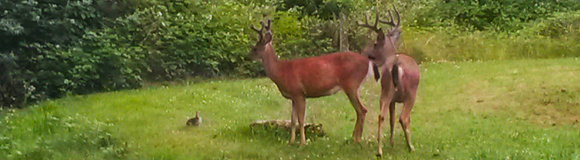
The following is from the Washington State Department of Fish and Wildlife website: Living with Wildlife
Food and Feeding Habits
- Deer eat a wide variety of plants, but their main food item is browse—the growing tips of trees and shrubs. In late winter and early spring, deer eat grass, clover, and other herbaceous plants (Table 2).
- Deer also eat fruit, nuts, acorns, fungi, lichens, and farm and garden crops if available.
- For their first few weeks of life, fawns thrive on milk, which is more than twice as rich in total solids as the best cow milk.
- Deer eat rapidly and, being ruminants, initially chew their food only enough to swallow it. This food is stored in a stomach called the “rumen.” From there it is regurgitated, then re-chewed before being swallowed again, entering a second stomach where digestion begins. From there it is passed into a third and then a fourth stomach, finally entering the intestine.
Shelter and Range Needs
- Deer are sometimes referred to as “edge” species, meaning they thrive at the interface of openings and cover patches. This allows deer to feed in productive openings while being close to escape cover.
- Many wooded suburban environments, such as parks, greenbelts, golf courses, and roadsides, meet the needs of deer.
- Mule deer can move long distances during spring and fall migrations to avoid mountain snow. Mule deer summering in the Cascades migrate as far as 80 miles to reach adequate winter range.
- Black-tailed and white-tailed deer normally reside within a ½ to 3 square-mile area; in mountainous locations, they move to lower elevations for the winter.

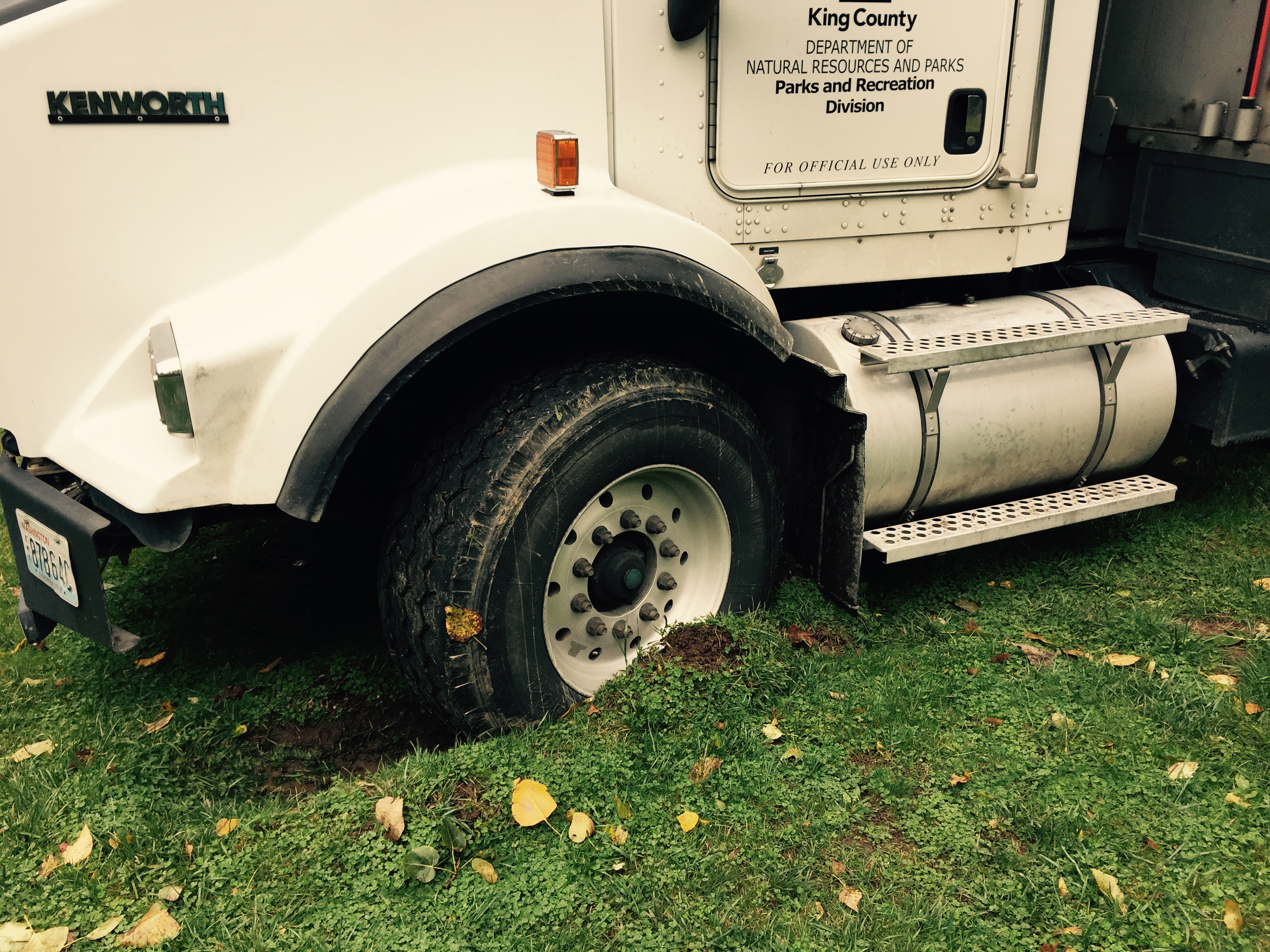
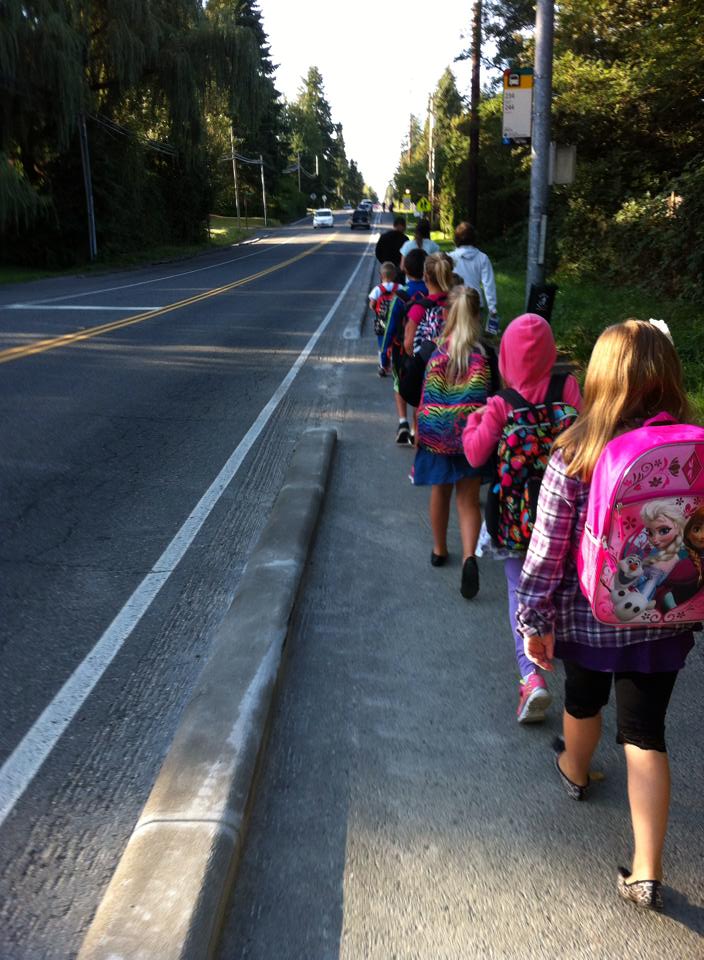
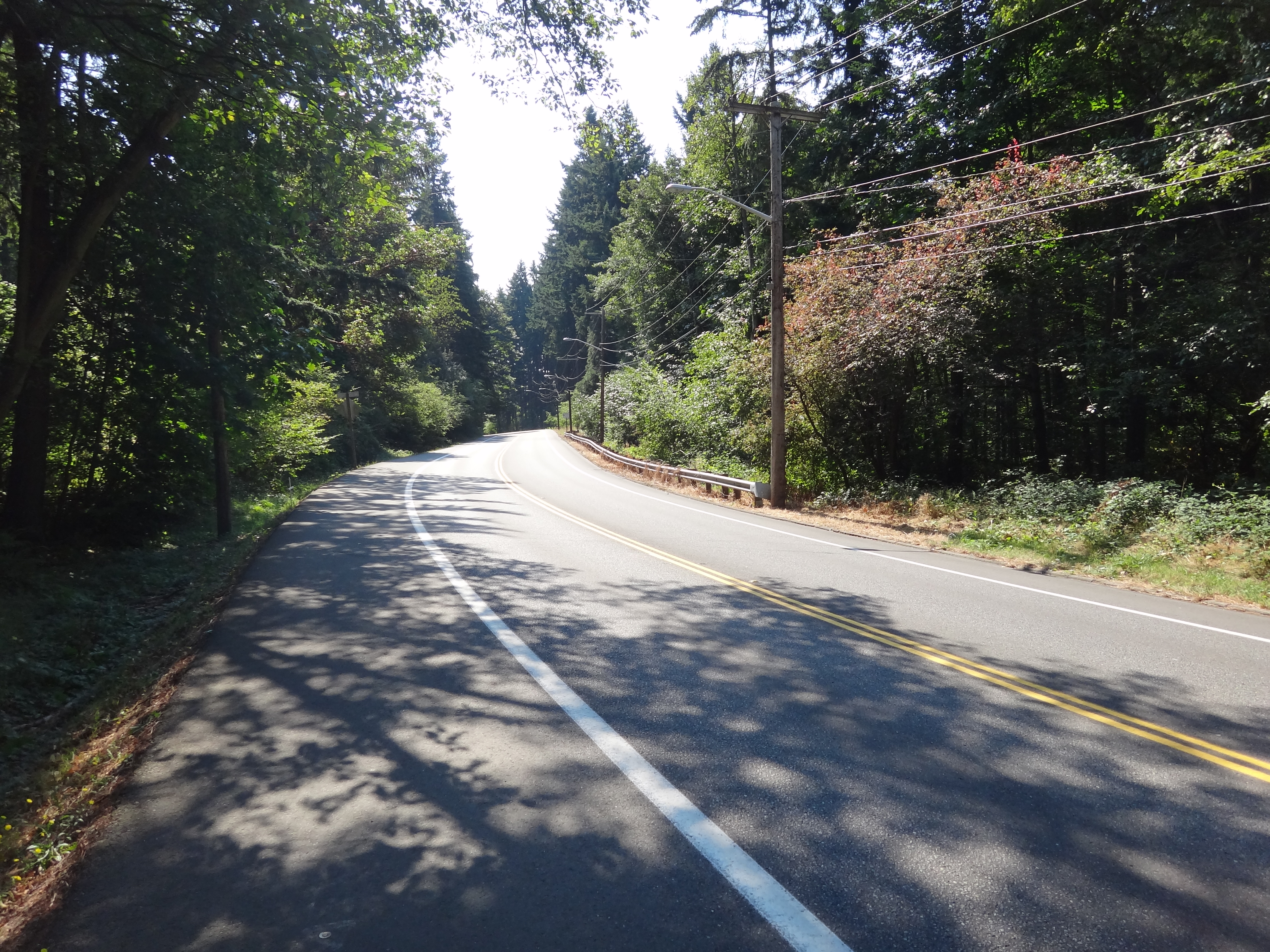

I’d like to know more about this deer meadow project. Why was this particular site on Juanita Woodlands chosen? Is the alliance working with the Department of Fish and Wildlife on this project? Are any biologists involved? Were neighbors on 80th Place NE adjacent to this project consulted or advised? Over the past few years we have witnessed small logging operations by King County Park reduce the tree cover here, apparently to address disease issues, and now more trees are being removed? We love the forest as it is — full of trees. Neighbors who live near the work being done say the site is a mess. Why?
(note: I am posting this for the coordinator of Juanita Woodlands activities).
Hello Mr. Johnson:
The Juanita woodlands is a county open space that was purchased in 1994 the King County Conservation trust. FHNA at the time, DCNA raised 1.5 million dollars in a year to save the woodlands. At that time arborists were brought in and did an assessment of the forest and submitted a restoration plan to the county which has been and continues to be implemented by the County and FHNA. The Deer meadow is part of this plan. The deer frequent the woodlands and the undeveloped property to the east of the woodlands. They have been on the hill and will continue to be here due to the ecological connectivity that exists in our neighborhood. As the area around the woodlands gets developed, the wildlife losses habitat. A healthy forest needs wildlife to survive.
If we leave the forest as it is, it will not survive. There are many diseased patches that will continue to degrade and eventually die. What the County and FHNA are attempting to do is keep the forest healthy and growing. Over the years we have planted 4200 trees in the woodlands to replace those that were removed. Currently the woodlands does not have the bio-diversity to sustain a healthy forest.
If you like living next to the forest and wish it to survive, please contact me and I can answer any questions you may have concerning the Woodlands.
Sincerely,
Teresa Chilelli-White
[Email deleted as the spam bots keep hitting this site]
425-501-4693
Mr Johnson: Thank you for your interest in Juanita Woodlands. FHNA is a strong proponent of the tree cover on Finn Hill and works hard to maintain the ecological balance on the hill.
The eastern part of Juanita Woodlands has had some changes recently. In addition to the study mentioned by Teresa, a few years ago one of the large douglas fir trees on the eastern side of the plot fell causing damage to a house and a fence (fortunately no humans were injured). King County Parks has assessed the area and discovered very serious patch of root rot in the stand of Douglas fir along the eastern edge. KC Parks had the option of leaving the trees to fall naturally and assume the liability of damaging houses, fences and people with a known risk or to minimize the risk with some selective cutting. As much as it pains any of us to lose the big trees, KC parks felt they didn’t have much choice.
You are quite right that area is a mess with big chunks of logs piled up and disrupted blackberries. Should you take a walk in the area you will see how efforts to re-vegetate the area are taking hold. Many of the 4000+ trees planted in 2011 and 2012 are six feet or taller.
You are always welcome to join the work parties (once or twice a year) which are well advertised. I’m sure Teresa would be happy to give you a private tour of the area (she seems to know every tree personally), give her a call, she’s your neighbor. If she’s not available, I’d be happy to join you for a walk in the park. Mike Crandell at King County Parks also can share a perspective.
All of Finn Hill has a problem with the health of the forests. Most of Finn Hill lost its tree cover in the early 1900s. In the 1920s and 30s a lumber company started planting, so the hill has a very uniform monoculture of Douglas fir. Very little of Finn Hill has a natural forest, and so does not have the diversity of a natural forest with the natural ecological succession and genetic diversity of the primary trees. As a consequence, when root rot of Douglas fir happens, its damage is substantial. Plantings are not including Douglas Fir, but cedar, shore pine, birch, maple, ash, spruce and others. The diversity will be of long term benefit.
The other major issue with the health of our forests is the rapid advance of invasive plants such as blackberry, English ivy, yellow archangel, holly, and laurel.
Hope this helps.
Thank you both for the replies! But I’ve got to say it’s nonsense to say that forest would not survive if left alone. Disease might kills some trees, but other native species would replace them, such as alder, maple and ultimately western hemlock. I can’t think of a single instance of a Western Washington forest not surviving when left to its own. Douglas fir is a native tree here, and that forest has a mix of other native species. The trees that came down on a house along the eastern edge of the forest fell in Dec. of 2006 during ferocious windstorm that toppled trees all over the hill, due to winds approaching 70 mph. I live just across the street. I don’t believe they were unhealthy; I think the county said that and took others out to relieve itself of any liability. Four or five mature cottonwoods along 120th were also removed from the forest at the same time — that area now is rampant with invasive and unsightly English ivy and Himalayan blackberry. That is not proper forest management. Why has the county not fixed what it created? Removing the ivy, blackberry and holly there would be a most worthy project for the county and the alliance — I would help! I am all for reforestation, but I have to wonder about some of the species selected — shore pine for example. It is native to our coast, but I have never in my 61 years here seen it naturally occurring in the interior of Western Washington. As for the deer, my observations are that the local population is larger right now than any time in the last 26 years. We see more now than any time since we moved near the woodlands in 1988. I have plenty of photos of them in the neighborhood over the last couple years; in the earlier years we saw them rarely. Although well-intended, I don’t think the meadow project is necessary, especially if it requires removal of any more trees. I cringe every time I hear the county chain saws in the forest. Was it necessary to cut a wide path with a Bobcat for the project? I think not, I’ve roamed all of that forest without a trail. It strikes me as entirely illogical to try to save the forest by removing its big old conifers. I donated serious funds to purchase that forest for the public. Please don’t kill it with your kindness. -Greg